


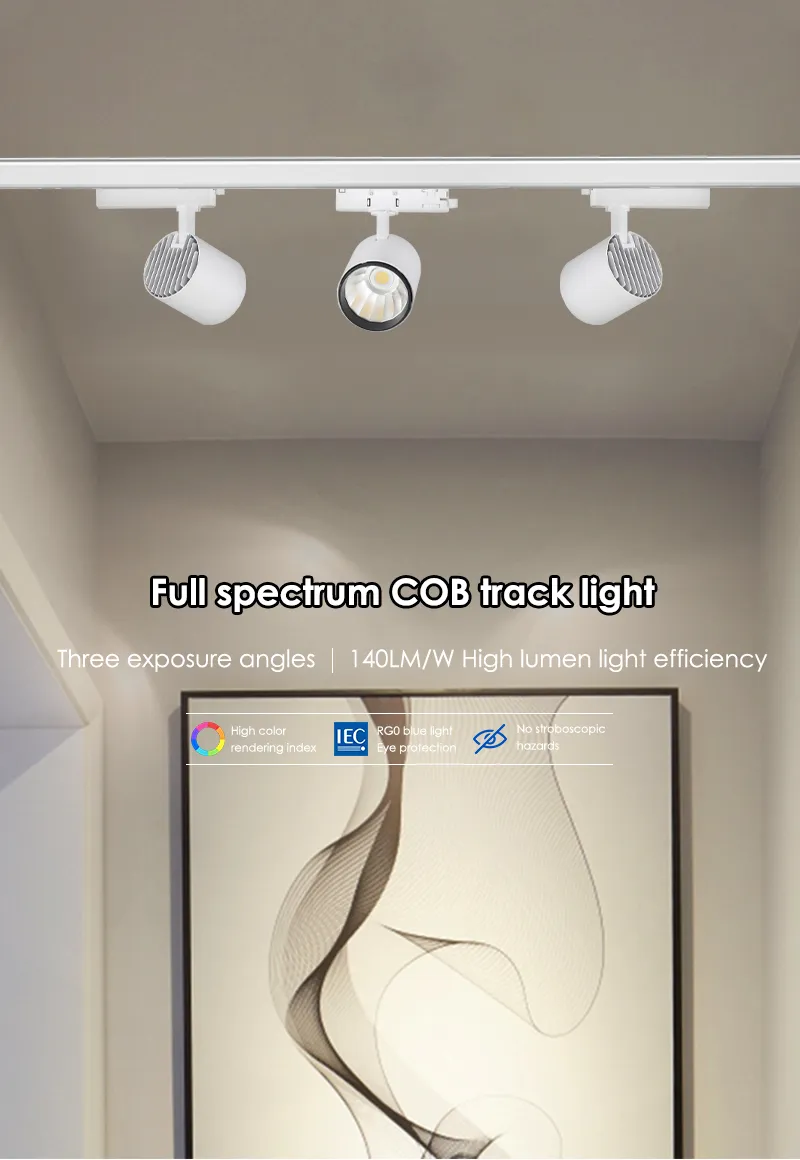
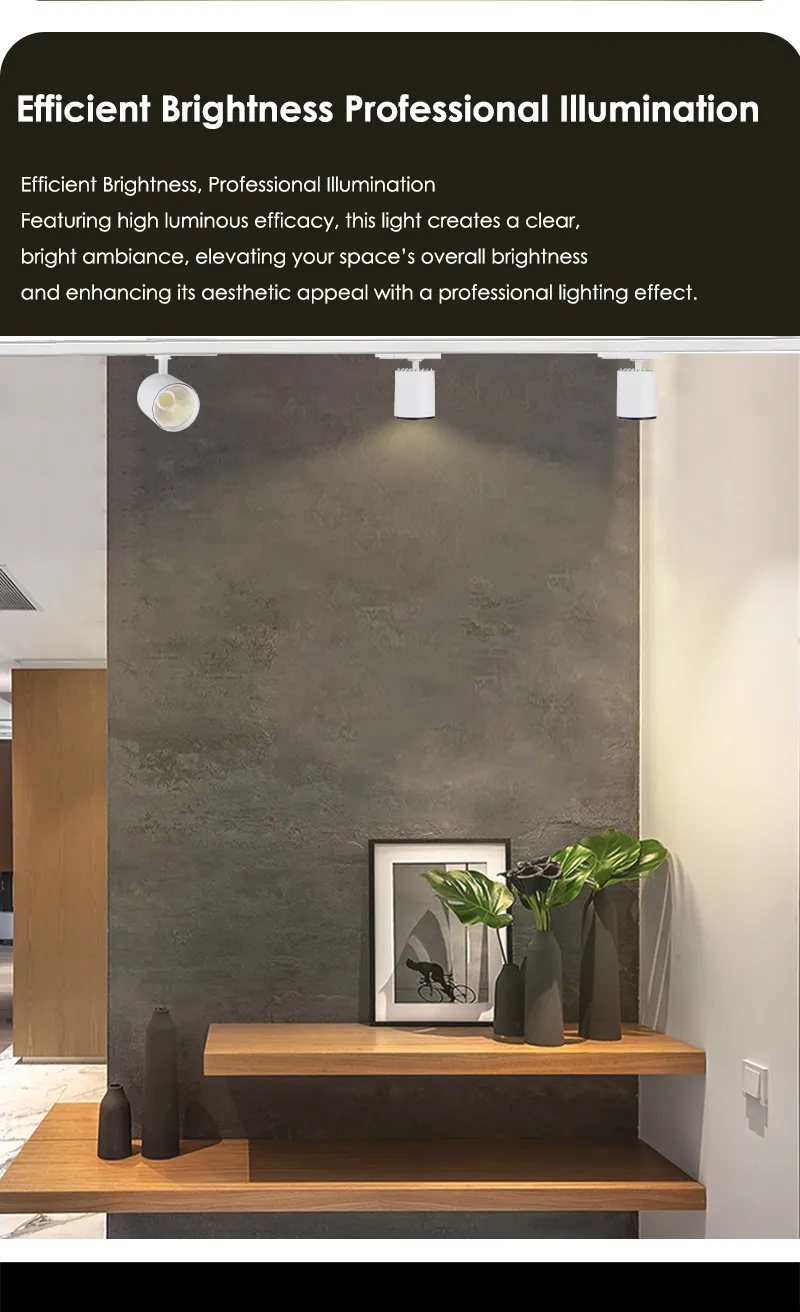
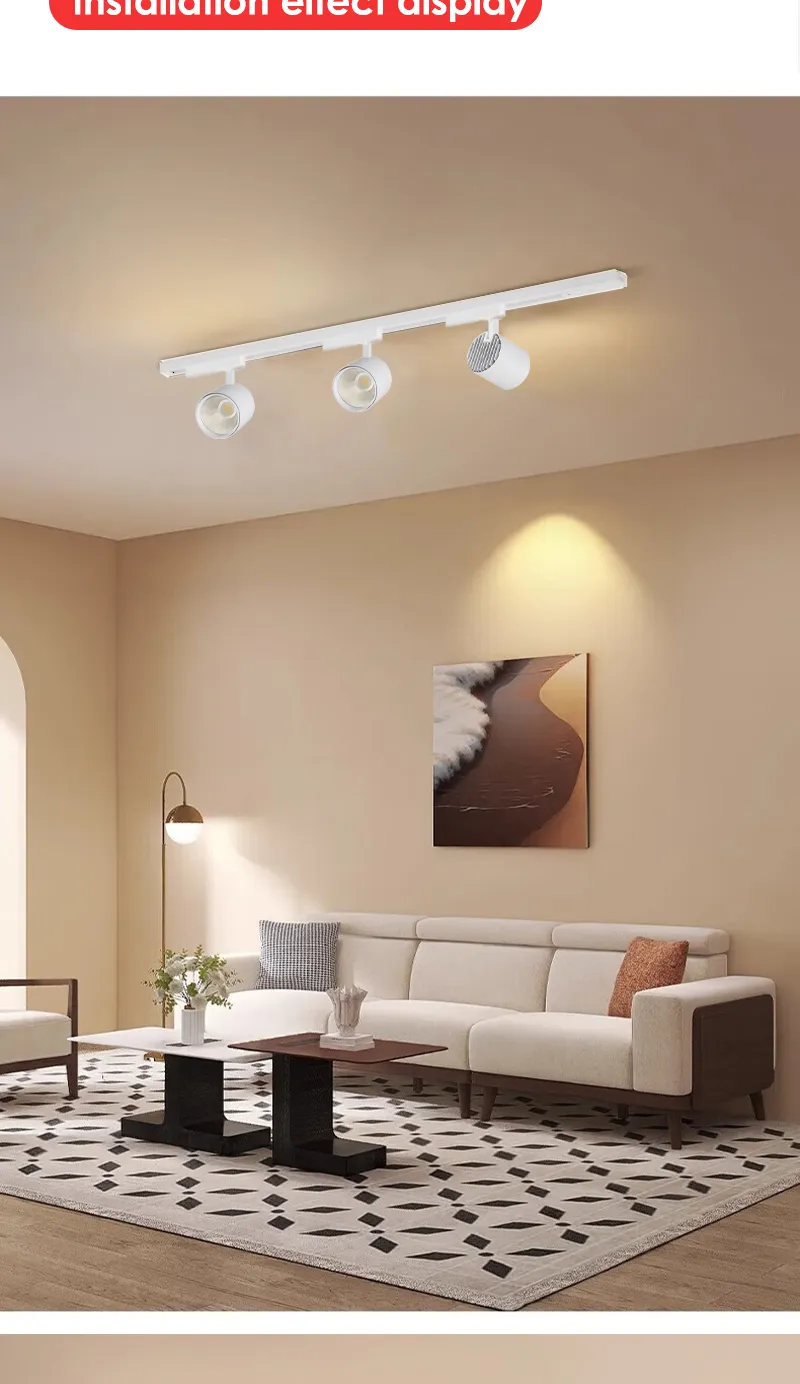
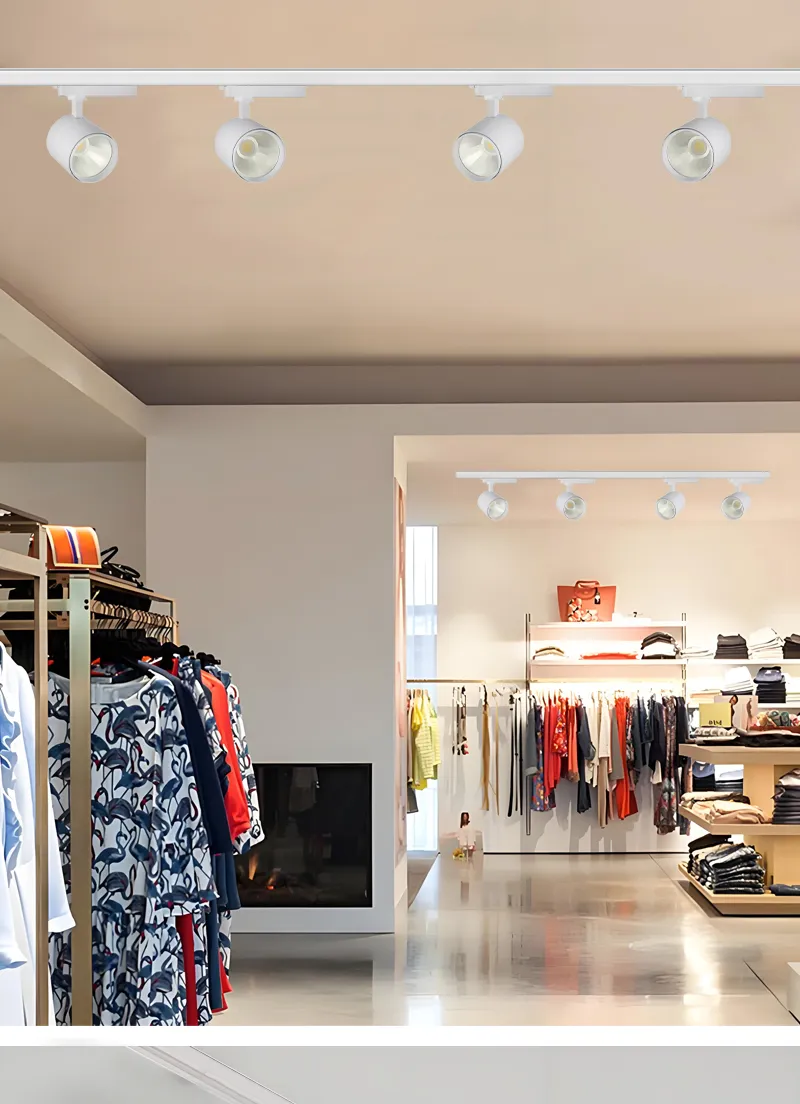
Track-mounted, aimable and built for the display line rather than the whole room: this is a COB LED track light for shop floors, showrooms and supermarket aisles. The head seats on a track rail and is turned by hand onto whatever has to be seen — a garment on a rail, a shelf edge, a counter display, a run of packaging — so the merchandise carries the light. It replaces halogen and first-generation LED track heads that needed re-lamping and shifted colour as they aged. Two housing finishes are offered, sand white and sand black, to follow a pale store ceiling or sit quietly against a dark one.
As LED track light manufacturers we build the housing, the reflector and the final assembly under one roof in Xiaolan, Zhongshan, so the head you specify is the head that arrives in the carton. That consistency matters more on a track light than on most fixtures, because a head like this is rarely bought once. It is ordered again when a store is extended, when a chain opens another branch, and when a single unit has to be replaced years after the original fit-out.
Most of the volume leaving the factory is led track light wholesale business — importers and wholesalers who keep the model as a stock line, contractors buying by the carton for shop fits, and project teams specifying it store after store. A single order almost always mixes configurations: the lower and the higher wattage, both head sizes, and more than one colour temperature, because no store wants identical light over a cash desk and over a deep aisle.
| Specification | Detail |
|---|---|
| Item No. | LD069 |
| Fixture type | COB LED track spotlight |
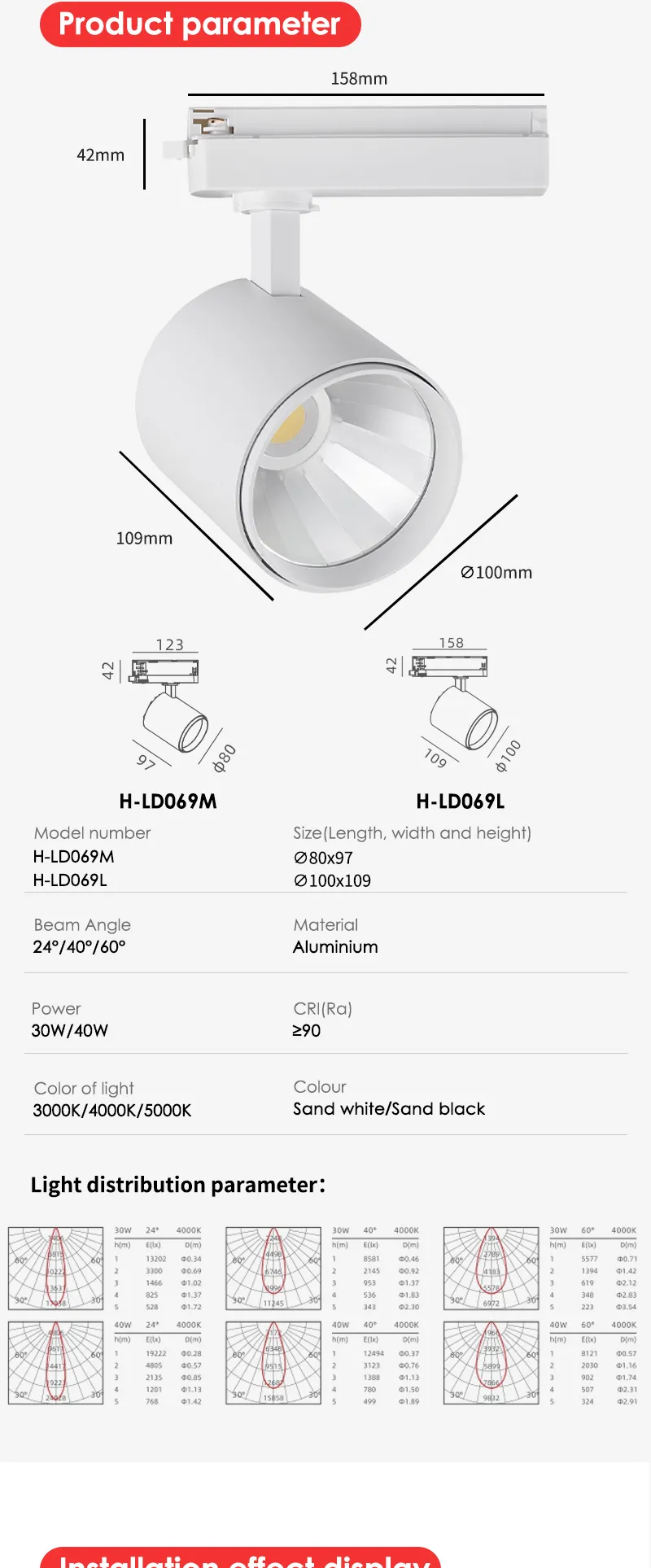
| Power | 30W / 40W |
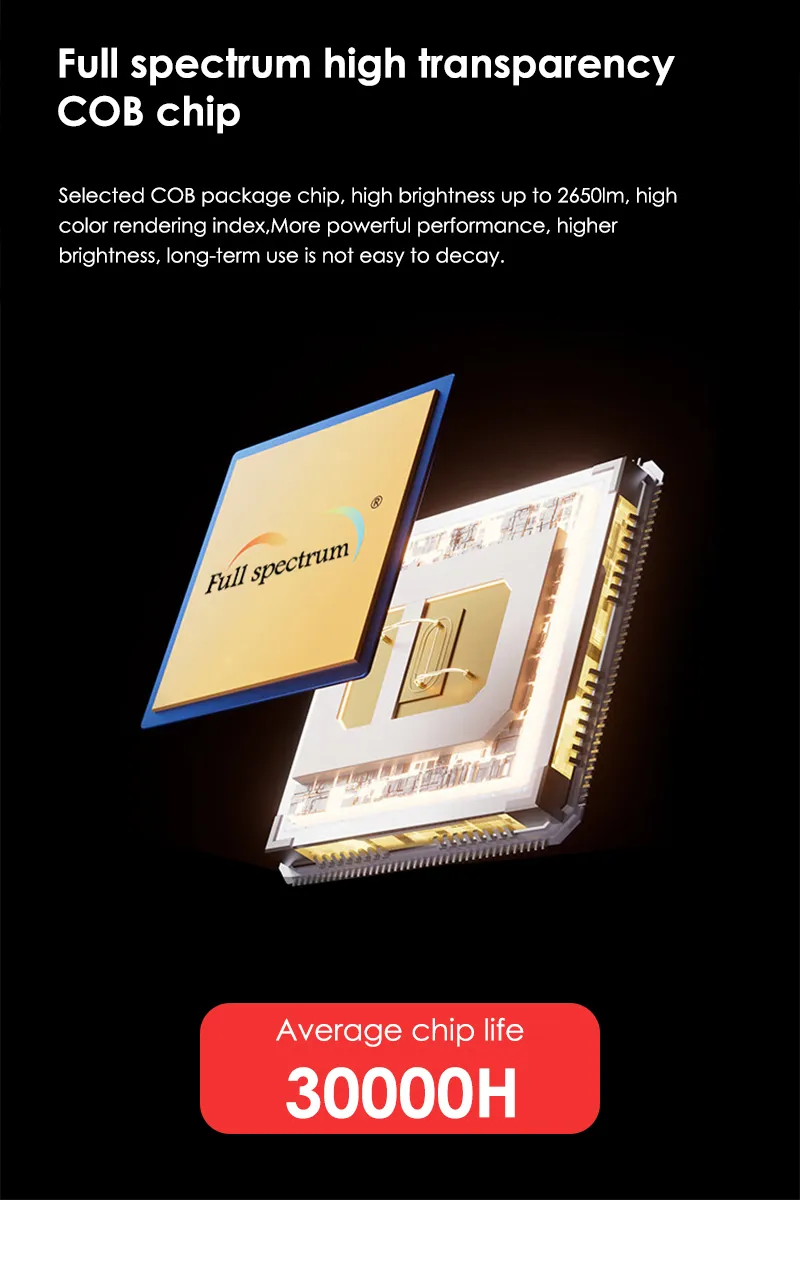
| Light source | Full-spectrum COB |
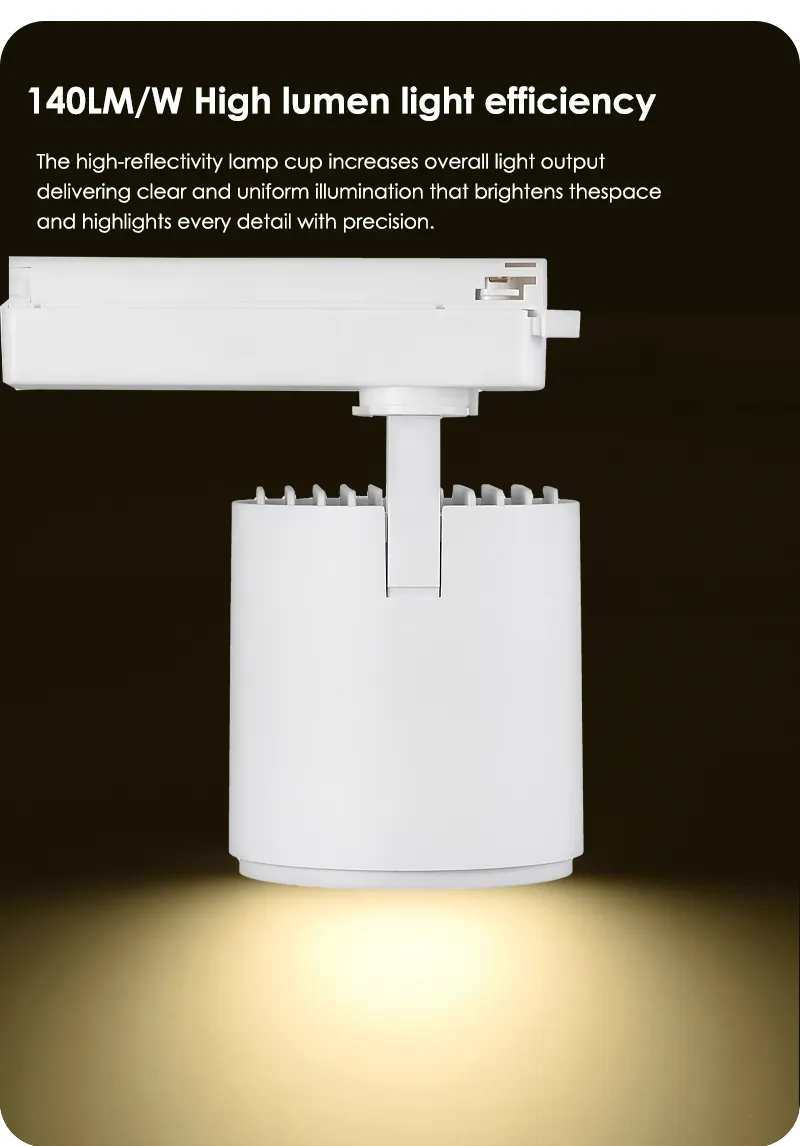
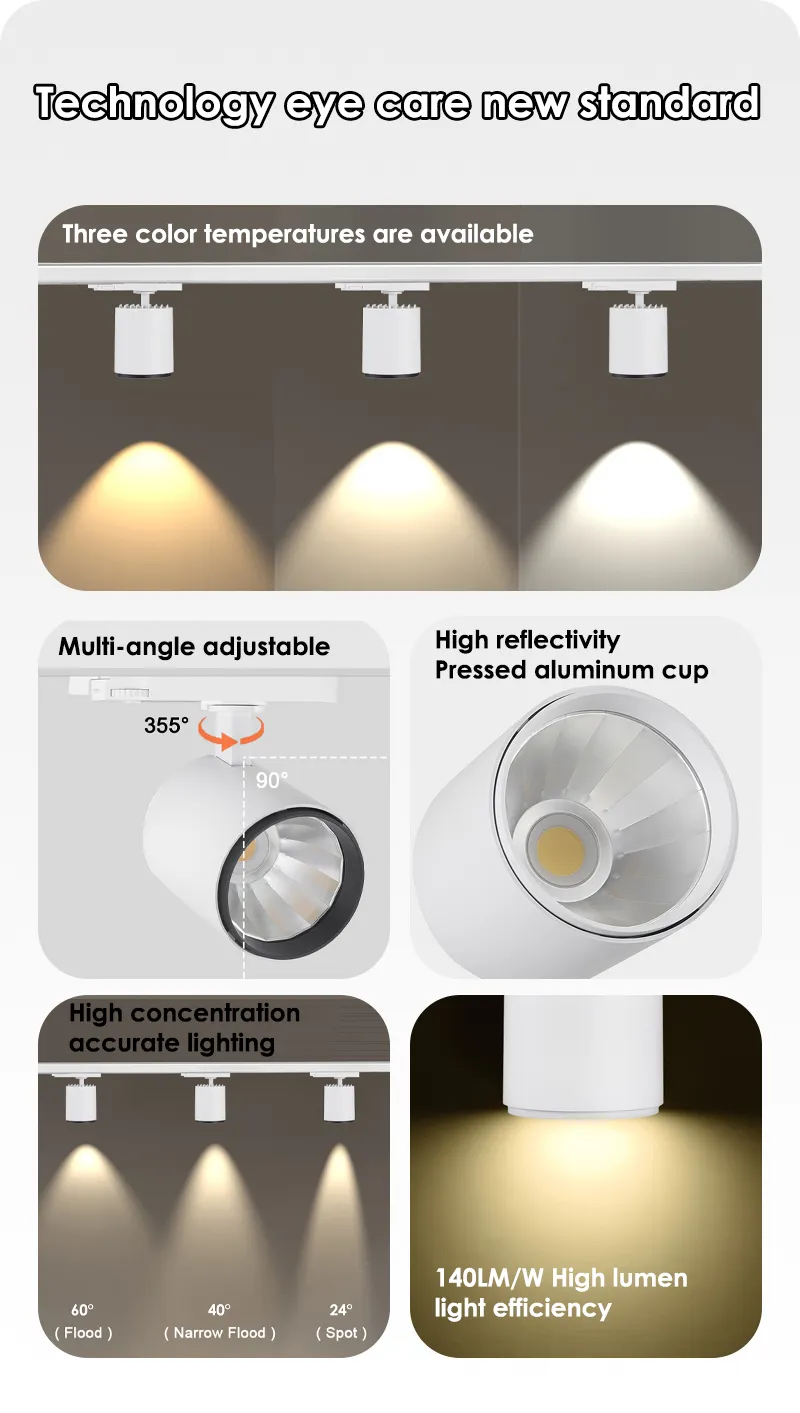
| Luminous efficacy | 140 lm/W |
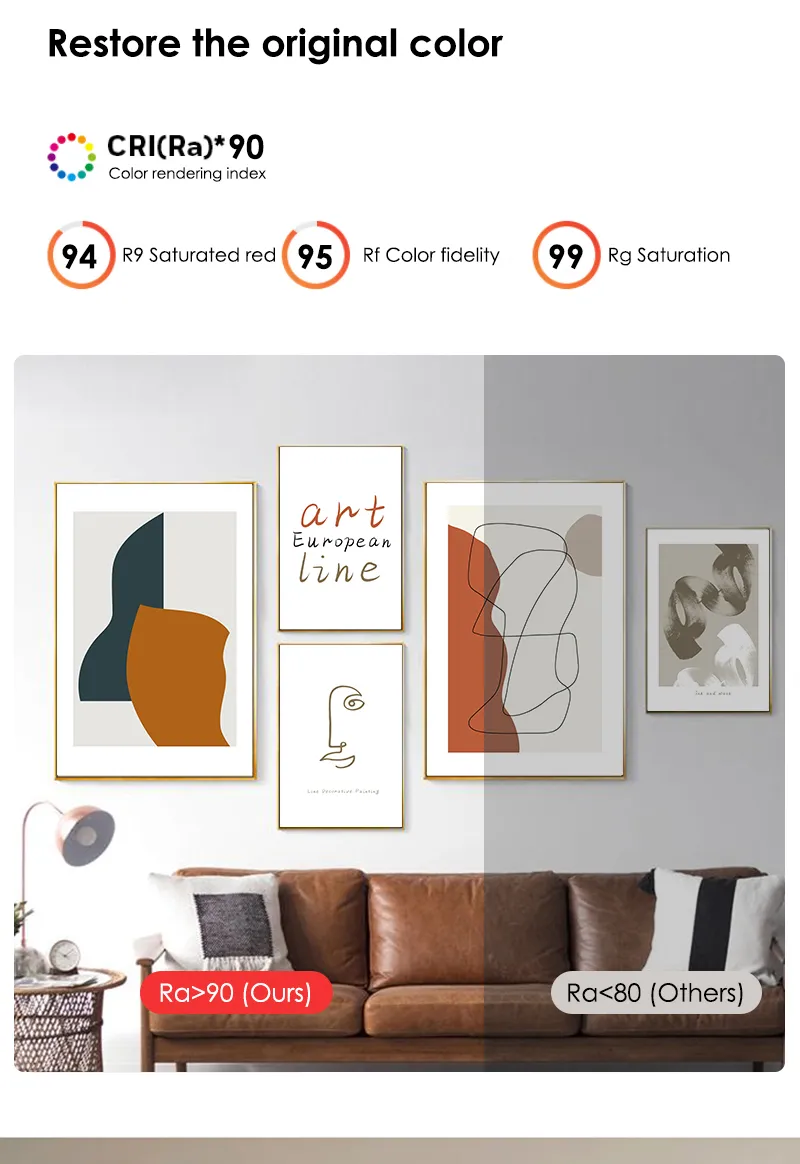
| CRI (Ra) | ≥90 |
| Colour temperature | 3000K / 4000K / 5000K |
| Housing material | Aluminium |
| Finish | Sand white / Sand black |
| Head sizes | Ø80 x 97 mm (H-LD069M) · Ø100 x 109 mm (H-LD069L) |
| Mounting | Track-mounted, adapter matched to your rail |
| Blue light | IEC RG0 |
The housing is aluminium rather than moulded plastic, and that is the part that decides how the fixture behaves across a long trading day. Heat leaves the COB through the body instead of collecting behind the lens, so an LED track light keeps its colour and output from opening to closing instead of drifting warmer as the evening goes on. A metal body also keeps the head rigid on the rail, which matters when the aim is reset every season.
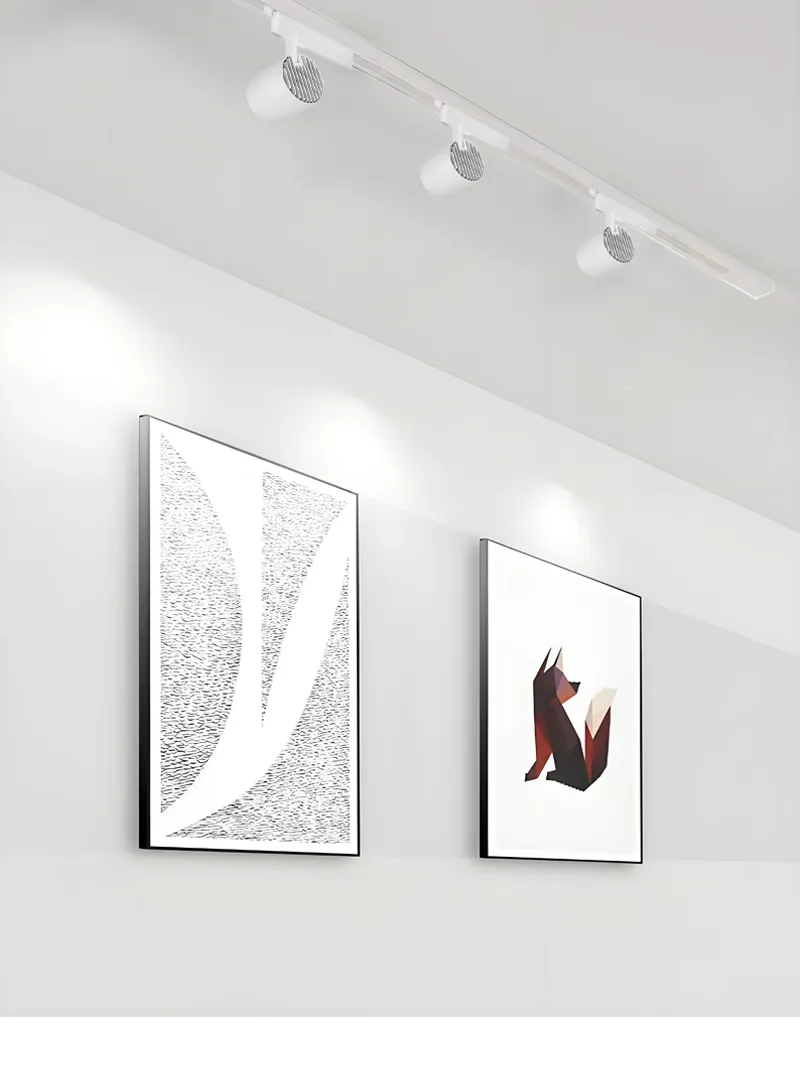
Sand white and sand black are the standard finishes, both with a matte sand texture rather than a gloss. Under store lighting a matte head reads as a flat surface instead of a bright reflection, which helps in shop windows and in anything photographed for a digital catalogue. The lens is set into the front of the body, and the painted surface is the part most likely to be marked during a fit-out, so heads should remain in their packing until the ceiling is ready.
If your specification names a material grade for the housing, a particular lens material or a sealing component, tell us what the project requires and we will confirm the exact specification rather than publish a generic number. Repeat orders are drawn from the same housing and the same finish, so keeping the item reference on file is the simplest way to make a later store extension match the original installation.
| Optical feature | Value |
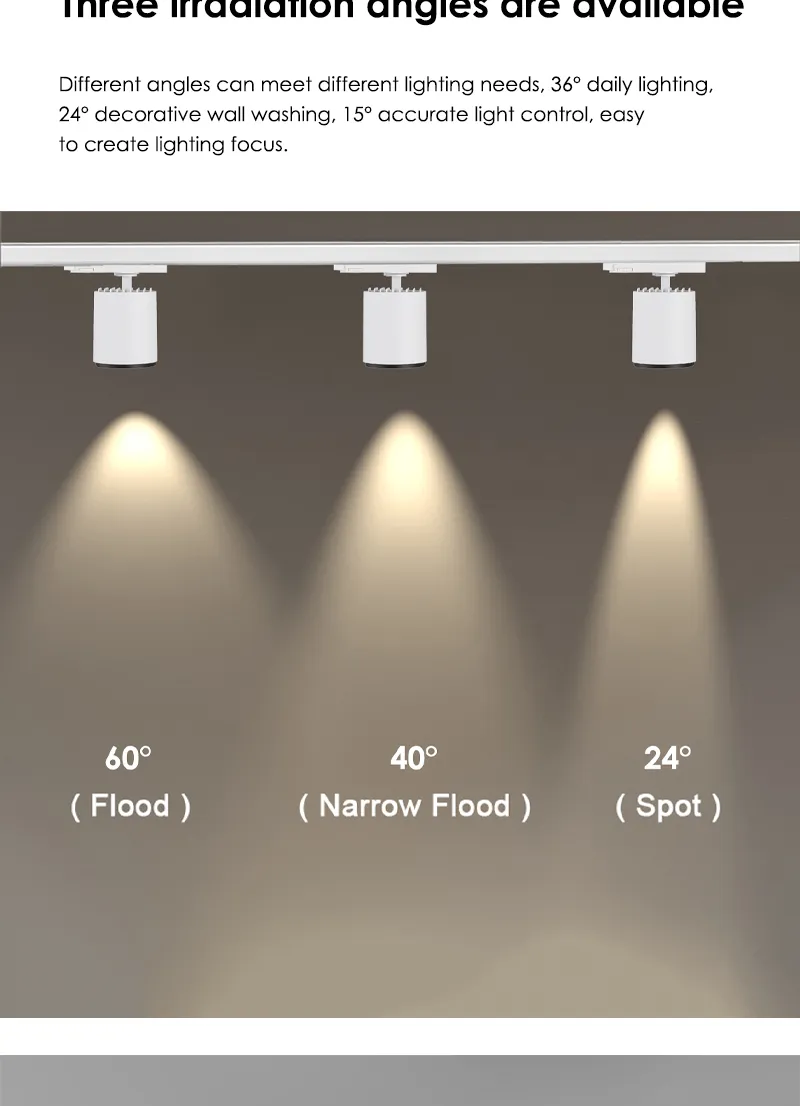
| Beam angle options | 24° / 40° / 60° |
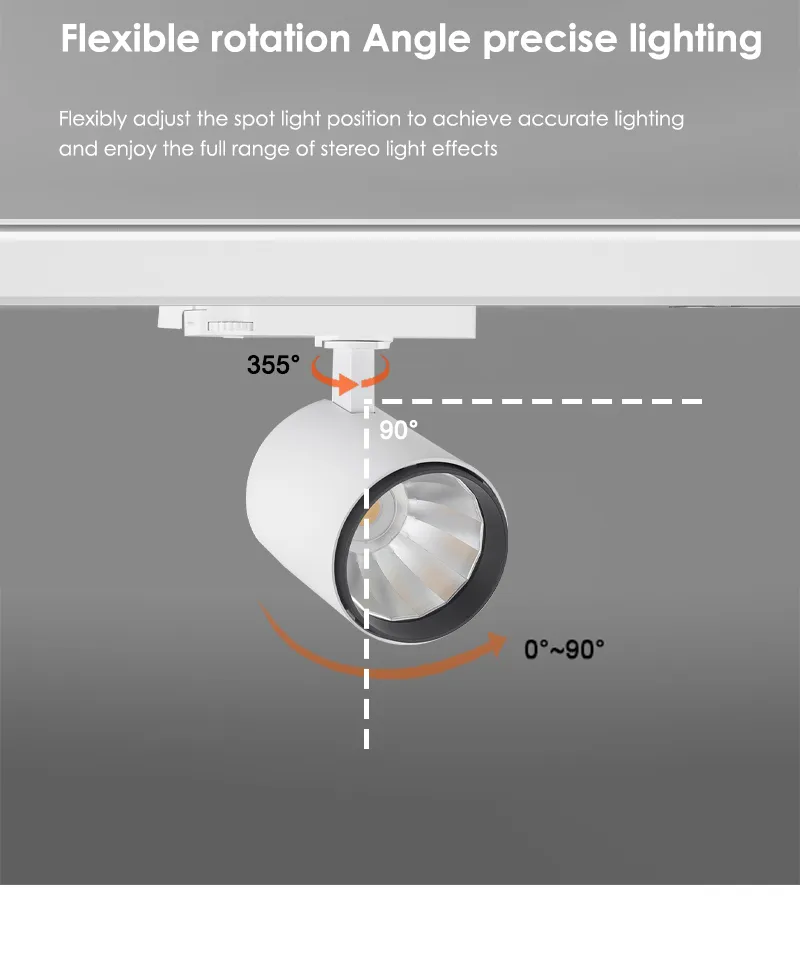
| Horizontal rotation | 355° |
| Vertical tilt | 0°–90° |
| Aiming adjustment | Multi-angle, set by hand at the head |
| Reflector | High-reflectivity aluminium |
| Beam direction | Aimed downward onto the display |
| 24° beam at work | A defined pool for a single garment, a plinth piece or a counter object, with the floor around it left darker |
| 40° beam at work | Even coverage across a shelf run or a mid-height display, where a narrow pool would leave gaps between lit items |
| 60° beam at work | A broad wash for wide display walls, gondola ends and open floor areas |
| Reflector function | Gathers the COB output and throws it forward into the chosen beam rather than letting it scatter inside the head |
| Tilt behaviour | A steep tilt drops the pool close to the rail; a flatter tilt sends it further into the aisle |
| Rotation in practice | The 355° sweep lets one head pick out a display on either side of the rail without repositioning the track |
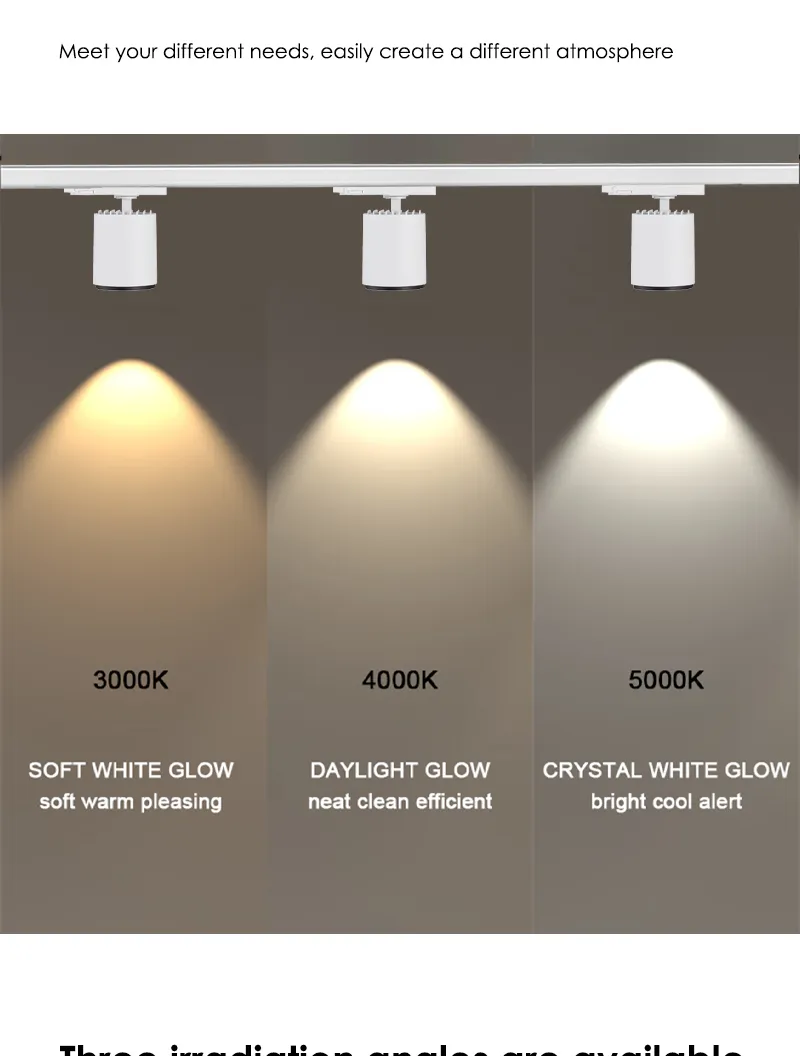
| Store area | Colour temperature | Why it works there |
| Entrance and threshold | 4000K | A neutral white that reads clean from the doorway and does not look yellow against daylight coming in from the street. |
| General sales floor and aisles | 4000K | The safest single setting across a mixed floor, and the one most commercial track lighting layouts settle on. |
| Apparel, footwear and fitting areas | 3000K | A warm white that holds skin tones, wool and richer fabric colours close to how they look in daylight. |
| Beauty, cosmetics and jewellery counters | 3000K | Warm light keeps skin tones natural and lets metal finishes and packaging carry their own colour. |
| Fresh produce, bakery and deli | 5000K | A crisp white keeps greens, bread crust and clear packaging looking fresh rather than dull. |
| Chillers, freezer aisles and hard goods | 5000K | Cool light reads clean against glass, metal and white appliance casings. |
| Hospitality corner, café and seating | 3000K | A quieter, warmer pool that separates a seating area from the trading floor without a change of fixture. |
| Cash desk and queue | Follow the neighbouring area | Keeping the till point on the surrounding setting stops it reading as a separate room. |
| The change between areas | Move the boundary, not the setting | Put the switch at a wall, a bay end or a step in the ceiling, never part-way down a run of shelving. |
| Multi-store roll-out | Same setting for the same area at every branch | A chain reads as one brand when branch three is lit like branch one, and it makes the next replacement head easy to specify. |
The head is built on a die-cast aluminium body, and the parts a project specification usually names are the housing alloy, the lens in front of the COB, the reflector and the sealing component that closes the head against dust. Where your own specification states a grade — an alloy for the housing, a lens material, a particular sealing compound — send it with the enquiry and we will confirm the exact build against it rather than quote a generic figure. That is the difference between a head that can be written into a tender document and one that cannot.
Finish is the other half of the order. Sand white and sand black are the standard colours, and the surface can be produced by different routes — powder coated, anodised or brushed — each of which changes how the colour reads under store light and how the surface behaves over years of cleaning. Tell us which the project calls for, or send a physical sample or a colour reference, and we will come back with what applies to this model and how it is held consistent from one batch to the next. Keep the item number and the agreed finish on file: a repeat order of this led track light is then drawn from the same housing and the same surface, so a branch fitted two years later still matches the first.
Quality and compliance are handled in-house at Huiheng Lighting. Our factory has held ISO 9001 and ISO 14001 management system certification, alongside BSCI, and our products carry CE, RoHS, ErP, CB, Reach, SAA and TUV approvals for the markets we serve. A CNAS-standard laboratory supports IES file testing and integrating sphere testing, so photometric and performance data can be checked before shipment. Declarations, test reports and compliance documents can be issued per project, with the applicable market scope confirmed together with your team before ordering. Tell us your destination market and required documents, and we will confirm what applies.
Both versions use the same COB source, the same optics and the same housing, so the quality of light is identical; the difference is reach and brightness. The lower wattage suits counters, lower ceilings and areas where contrast matters more than raw output. The higher wattage is the one for taller sales halls, large-format stores and displays set further back from the ceiling. A floor that mixes deep and shallow zones normally uses both, with the stronger head over the deeper areas.
Match the angle to how tight the display is. The narrowest option is for jewellery cases, mannequins and single-product features, where the point is a sharp pool of light with no spill into the aisle. The middle angle covers wall bays, shelving and most commercial track lighting. The widest option is the one for supermarket aisles, entrances and long runs of shelving that have to read evenly from the bottom shelf to the top. Stores with a mix of display types normally order two of the three.
Send us the rail profile, or a clear photograph of the existing track, and we will match the adapter. Rail profiles differ between manufacturers, and the two common families — high-voltage track and 48V magnetic track — take different adapters, so it is worth confirming the rail before an order is committed to it. The fitting itself is a standard-format LED track light head that can be re-aimed by hand once it is seated.
The warmest setting flatters skin tones, timber and richer fabric colours, which is why it is usual in apparel, beauty counters and hospitality areas. The middle option keeps whites, packaging and cosmetics looking clean and true, and it is the safest choice across a general sales floor. The coolest reads crisp and bright, so it suits fresh produce, chillers and hard goods. Large stores often run more than one, with the change happening at a zone boundary rather than part-way down an aisle.
Yes. The head rotates on its base and tilts through its range, so the aim can be reset after the ceiling is finished and again when the merchandising changes for a new season. Set the angles from the aisle where the shopper stands rather than from under the rail — a head that looks right from a ladder is usually wrong from eye level. There is no need to take a head off the rail to change its aim.
The head is the fixture; the rail, adapter and driver are separate parts of the same track range. If you are extending an existing track, tell us the rail family and we will confirm the adapter. If the rail and driver are part of the same project, they can be matched to the heads so the run arrives as one system rather than as parts to be sorted on site. Tell your sales contact which parts of the system the installation already has.
Private-label orders are routine on this range. Tell us what has to differ from the standard sand white and sand black — a badge, a housing colour, a specific mix of colour temperatures or a wattage split — and the details can be settled before production is scheduled. As LED track light manufacturers we handle the housing, the reflector and the assembly ourselves, so a badge or finish question is answered by the people who build the head rather than passed along a chain.
Switch the circuit off and let the heads cool before touching them. A soft dry cloth is enough for the housing and the lens, and a slightly damp cloth lifts finger marks from the painted body. Keep solvent cleaners, abrasive pads and spray polish away from the matte sand finish, since they cut into the texture and leave a shine that shows under store lighting. In a working store, cleaning is easiest as part of the normal high-level dusting cycle, when the heads can also be checked for any that have been knocked out of aim.


